
Careers & Courses
Job Oriented Courses After Graduation: How to Choose One That Actually Gets You Hired

Short answer: The best job oriented courses after graduation are short (three to nine months), built around one entry-level job you can name, and finish with work you can show an employer. In 2026 the strongest options for Indian graduates are Python and data analysis, full stack web development, cloud and DevOps, digital marketing with AI tools, UI/UX design and mobile app development. Choose by your degree and the job you want, not by whichever course shouts loudest about placement.
Most graduates don't need a second degree. They need one skill an employer will pay for, plus proof they can use it. That is the honest promise of job oriented courses after graduation, and it's why the search is so crowded: nearly every institute in India now calls its programme "job oriented".
The guides that rank for this question mostly hand you a list of course names. Useful, up to a point. What they skip is the part that decides whether the money and months pay off: which course fits your degree, how to test a placement claim before you pay, and what to do in the weeks after the certificate arrives. That's what this guide covers.
What makes a course "job oriented"?
A job oriented course is a short, skill-focused programme designed around a specific job role, with a syllabus that mirrors what employers ask for in real job listings. Run these four tests on any course you're considering:
- It names the job. "Junior data analyst" or "SEO executive" is a target. "Become industry-ready" is not.
- The syllabus matches real listings. Open ten job posts for that role on any job portal and tick off the skills they mention. The course should teach most of them.
- It ends with proof. A capstone project, a GitHub repository, a live ad campaign, a Figma case study. Something an interviewer can open.
- It fits in months, not years. Most good career oriented courses run three to nine months part time.
If a course fails two of these tests, it's a hobby course with good marketing.
What the 2026 hiring data says about your degree
The India Skills Report 2026, released in November 2025 by ETS with CII, AICTE and AIU, tested more than one lakh candidates and gathered responses from over 1,000 employers. Its employability scores by stream are a useful reality check:
| Stream | Employability |
|---|---|
| Computer Science | 80% |
| IT | 78% |
| MBA | 72.76% |
| B.E. / B.Tech | 70.15% |
| Commerce | 62.81% |
| Science | 61% |
| Arts | 55.55% |
Two things stand out. IT still accounts for about 35% of fresher hiring, and the report says demand for AI, data, cloud and cybersecurity skills is running ahead of supply. Meanwhile, employability for B.Tech and MBA graduates actually slipped compared with 2025. A degree, even a technical one, isn't the edge it used to be. A specific, provable skill is.
So if you studied arts, commerce or science, a short technical or digital course is the quickest bridge to better-paid work. If you're an engineer, the course is how you specialise.
Best job oriented courses after graduation, by degree
Start here. Find your degree, then read the roles in the third column and make sure they appeal to you before you open a single course brochure.
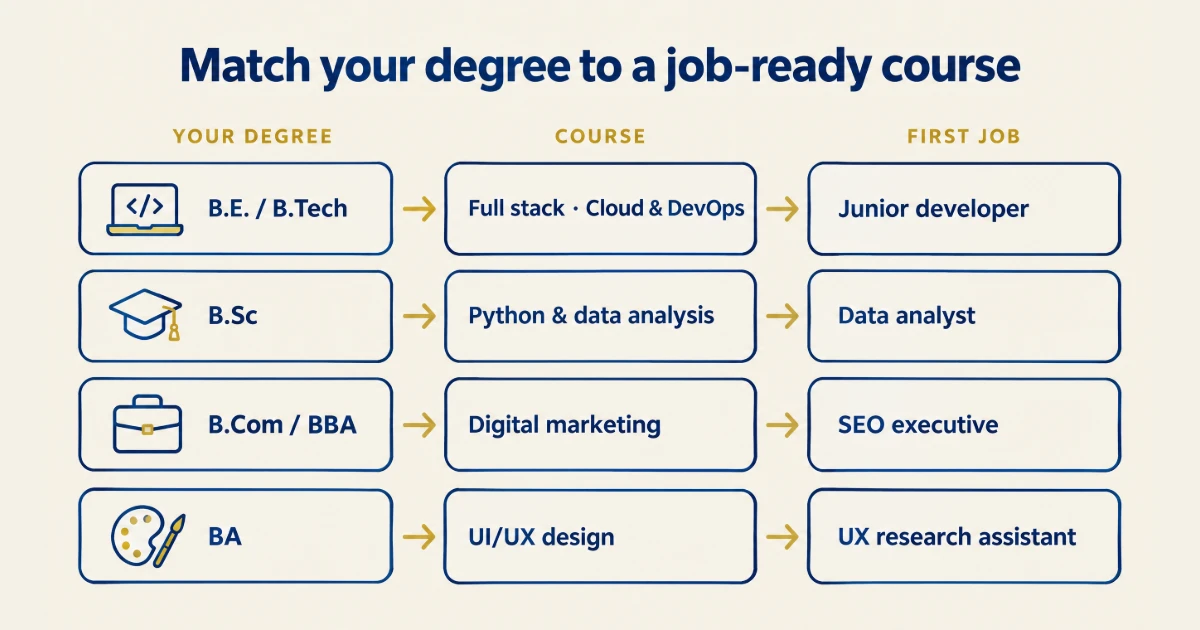
| Your degree | Courses that fit | First roles to aim for | Time to job-ready* |
|---|---|---|---|
| B.E. / B.Tech (any branch) | Full stack development, cloud and DevOps, Python for data | Junior developer, cloud support associate, DevOps trainee | 4–8 months |
| B.Sc (CS, maths, physics, statistics) | Python and data analysis, Java, full stack | Data analyst, junior Python developer, QA engineer | 4–6 months |
| B.Com / BBA | Digital marketing, performance marketing, data analysis with Excel, SQL and Python | SEO or SEM executive, marketing analyst, MIS executive | 3–6 months |
| BA (English, economics, psychology and others) | Digital marketing, content and SEO, UI/UX design | Content marketer, social media executive, UX research assistant | 3–6 months |
| Life sciences, pharmacy, allied health | Python and data analysis, healthcare-focused digital marketing | Research data assistant, healthcare marketing executive | 4–6 months |
*Our estimate for someone putting in 10–15 hours a week, including time to build projects. Faster is possible with more hours; slower is normal if you're already working.
Still unsure which direction suits you? Before you compare fees, spend fifteen minutes on this practical video on choosing a career path after graduation. It won't decide for you, but it will help you rule things out.
The best job oriented courses to consider in 2026
1. Python and data analysis
Python is the most flexible first skill you can learn. The same basics lead to data analysis, automation, software testing and back-end development. A solid course covers syntax and control flow, functions and modules, lists and dictionaries, reading and writing files, JSON and CSV, then moves on to SQL, pandas and simple charts.
Proof to finish with: two or three small analysis projects on public data, each with a short write-up of what you found. Good fit for: engineers from any branch, science graduates and commerce graduates who like numbers.
If you've never written a line of code, watch how Python is installed and set up on Windows and Mac and try it yourself before you pay for anything. If that first hour feels like fun, you're in the right place. CareerGateway's Software Development with Python course is a self-paced, beginner-level option that ends with a capstone project you can walk an interviewer through. Searching for a python course with placement? Read the placement section below first.
2. Full stack web development
Companies of every size need people who can build and maintain web applications. Full stack means you handle both sides: the front end people see (HTML, CSS, JavaScript and a framework such as React or Angular) and the back end that stores and serves data (a server language such as PHP or Node, plus a database and APIs).
Proof to finish with: one complete, deployed application, such as a booking system or an inventory tracker, with its code on GitHub. Good fit for: engineers, B.Sc graduates and anyone who enjoys seeing what they build. CareerGateway's Full Stack Web Development training runs through seven project-driven lessons, from semantic HTML to planning and building a complete application.
3. Cloud computing and DevOps
Almost every new application runs on AWS, Microsoft Azure or Google Cloud, and someone has to set up, secure and automate that infrastructure. Entry roles include cloud support associate and DevOps trainee. You'll need comfort with Linux, basic networking and at least one scripting language.
The advantage here is portability. Vendor certifications such as AWS Certified Cloud Practitioner or Microsoft Azure Fundamentals are the same exam worldwide, so employers in India, Australia or the Middle East read them the same way.
4. Digital marketing with AI tools
This is one of the most practical career oriented courses after graduation for commerce and arts students. A good programme covers SEO, Google Ads and Meta Ads, email, social media, Google Analytics, and how to use generative AI tools for research and first drafts without publishing generic copy.
Proof to finish with: a real campaign, even a small one for a friend's shop, with before-and-after numbers. CareerGateway's Digital Marketing Training with AI Tools ends with exactly that: planning and launching a multichannel campaign.
5. UI/UX design with Figma
UI/UX designers decide how apps and websites look and how easy they are to use. It suits people who notice when something is confusing and want to fix it, which is why psychology, design and English graduates often do well. Employers hire from portfolios, so plan for two or three case studies that show your research, sketches and final screens.
6. Mobile app development
Flutter lets you build Android and iOS apps from one codebase, which makes it popular with startups and agencies. It's a good next step if you already know some programming; complete beginners usually do better starting with Python or web basics.
Longer routes worth knowing about
Credentials such as CA, CFA, CPA and PMP appear on many "best job oriented courses" lists, but they aren't short-term courses. They involve several exams and, in some cases, work experience. PMP, for example, requires years of project experience before you can sit the exam. If you want an entry-level project management credential straight after graduation, look at PMI's CAPM instead.
Short term job oriented courses vs a PG diploma or MBA
| Factor | Short-term skill course | PG diploma | MBA |
|---|---|---|---|
| Typical length | 3–9 months | About 1 year | 2 years |
| Upfront cost | Lowest | Moderate | Highest |
| Best when | You want a specific job soon | You need a recognised qualification in one field | You're aiming at management roles and can afford the time |
| Main risk | Weak courses with no real projects | Theory-heavy syllabus | Two years without earning |
Many graduates do both in sequence: a short course to start earning, then a part-time diploma or executive MBA a few years later, often with employer support.
IT courses with placement: how to check a claim before you pay
"IT courses with placement" and "software training with placement" are among the most searched phrases in this space, and among the most abused. Before you pay, ask these questions and get the answers in writing:
- Batch numbers, not lifetime totals. "Of the students in your last two batches, how many got offers within six months, and what was the median salary?"
- Who counts as placed? Some institutes count unpaid internships, or jobs students found on their own.
- Three recent employers by name. Then search LinkedIn for people who list that course and work at those companies.
- What "placement assistance" includes. Resume reviews? Mock interviews? How many interview referrals?
- Refund and "pay after placement" terms. Income share agreements can end up costing more than the fee.
Red flags: a "100% placement guarantee", pressure to pay today for a discount, no syllabus before payment, and trainers you can't find anywhere online.
For transparency: CareerGateway's courses don't promise placement. They're self-paced, come with a certificate and a capstone project, and sit alongside CareerGateway's job listings across India, Australia, Canada, Europe, Singapore and the Middle East.
How to read fresher salary numbers without being misled
Salary figures in course ads are usually the best case. For a realistic picture, search the exact job title on two or three salary sites, filter for zero to one year of experience in your city, and look at the median rather than the top figure. Large IT services firms still hire freshers in the low single-digit lakhs per year. Product companies and specialist roles pay more, but they also screen harder, and a strong portfolio is what moves you from the first group to the second.
Self-paced, live or blended: which format suits you?
Self-paced courses suit people who are already working, or who can hold a schedule without someone checking on them. Live batches suit people who need a teacher to keep them on track. Blended courses mix the two. Whichever you choose, block 10 to 15 hours a week in your calendar before you enrol. Finishing matters far more than format.
Courses that also open doors abroad
None of the top-ranking guides mention this, but it matters if you might work overseas later. Skills with a global standard travel well: cloud certifications, programming, data analysis and digital marketing tools work the same way in Chennai, Melbourne and Toronto, and a GitHub profile or online portfolio is just as easy for a recruiter abroad to check.
Keep expectations grounded, though. A short course on its own rarely meets work visa or skilled migration rules, which usually look at your degree and years of experience as well. In Australia, for example, ICT skills for migration are assessed by the Australian Computer Society. Treat the course as the start of the experience that makes those applications strong.
Your first 90 days after the course
- Days 1–30: polish your proof. Finish two projects properly, write a short README for each and put them on GitHub. If you've never used it, this beginner's walkthrough of Git and GitHub covers what you need. Change your LinkedIn headline to the job title you want.
- Days 31–60: apply with focus. Send 10 to 15 tailored applications a week for one job title. Message three people a week who already do that job and ask them one specific question.
- Days 61–90: practise and adjust. Do mock interviews, take a freelance or internship project if one comes up, and look at which applications got replies. If responses are low, change your resume, not your goal.
Frequently asked questions
Which is the best job oriented course after graduation?
There isn't one best course for everyone. The best job oriented course is the one that matches your degree and a specific entry-level job you can name. For engineering and science graduates that is usually full stack development, Python and data analysis, or cloud and DevOps. For commerce and arts graduates, digital marketing and UI/UX design are the most common bridges into well-paid work.
Can I get a job after a 3-month course?
Yes, but the course alone rarely does it. Graduates who land jobs after short courses usually finish with two or three projects they can show, a resume aimed at one job title, and steady applications over the following two to three months.
Which job oriented courses suit B.Com graduates?
Digital marketing, performance marketing and data analysis with Excel, SQL or Python suit B.Com graduates well because they build on comfort with numbers. They lead to roles such as SEO executive, marketing analyst and MIS executive.
Which course is best after BA for a job?
BA graduates do well in digital marketing, content and SEO, and UI/UX design, where writing, research and understanding people matter. Build a small portfolio during the course so employers can see your work, not just your certificate.
Are online certificate courses accepted by employers in India?
Most private employers care more about what you can do than where you learned it. An online certificate helps you get shortlisted; your projects and interview performance get you hired. Vendor certifications such as AWS or Microsoft Azure carry extra weight because the exam is standardised.
Is a 100% placement guarantee real?
Treat it with caution. Ask for batch-wise placement figures, the names of recent hiring companies and the guarantee terms in writing. Many guarantees count internships or self-found jobs, or refund only part of the fee after strict conditions.
Can a non-IT graduate move into IT through a short course?
Yes. Many testers, data analysts and front-end developers in India come from non-IT degrees. Expect four to eight months of steady practice, start with Python or web basics, and pick a first role that values projects over a computer science degree.
How many hours a week does a job oriented course need?
Plan for 10 to 15 hours a week if you want to finish a four to six month course on time. Working graduates often do better with self-paced courses and a fixed weekly schedule than with evening live classes they can't always attend.